
Written and edited by Ruby Lee Schembari
There are dozens of small businesses scattered throughout Northern Portland, but there’s only one hole-in-the-wall shop I find myself regularly visiting and buying things from, a Nice Lady in St. Johns.
This cozy custom embroidery shop is owned and operated by Lynn Campbell Daly, who has been running her store out of the MARVEL 29 apartment complex shops for the past five years.
Since I first met Ms. Daly in April of 2026, I have purchased several items from her shop, including a custom apron, a tank top, and a Grateful Dead shirt. All of which I use or wear regularly. So, to show my appreciation for one of my favorite local shops, I decided to sit down with Ms. Daly to get a sense of who she is and what her business is about.
But before our interview, I wanted to get a sense of what her job was like, so I asked her for a brief overview. Initially, I cut the loose strings dangling from the back of a stitched design tote bag for The Carson J Bride Effect, a nonprofit dedicated to raising awareness of the serious consequences of cyberbullying.
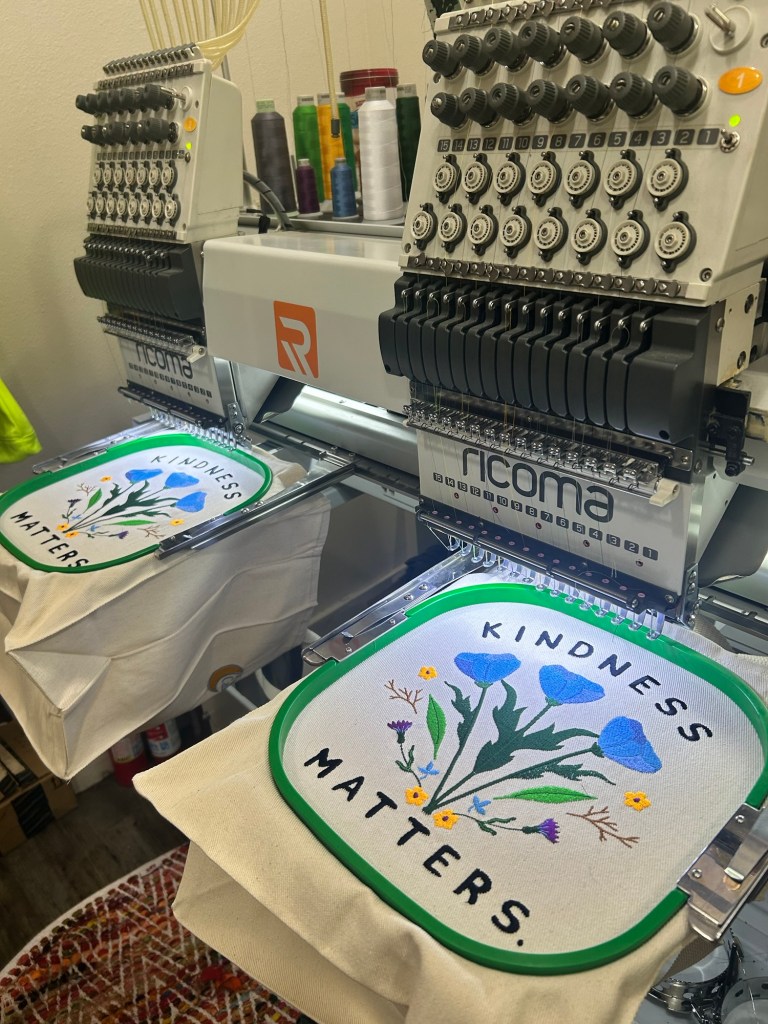
After cutting the strings and collecting them with a lint roller, she showed me how to operate her Ricoma MT 1502, a two-head, 15-needle commercial-class embroidery machine capable of sewing up to 1000 stitches per minute. Additionally, it can store up to a million stitches, which translates to about 1,000 different designs. I’ll be honest, this was one of the most complex pieces of machinery I had ever seen in my life.
After watching the Ricoma stitch away on two tote bags, we decided to sit down and talk about what makes her a Nice Lady in St. Johns.
RLS: How long have you been based here in St. John’s?
LCD: Five years. I was gonna open up, and then COVID happened. As soon as we were able to reopen after COVID, I put up my open sign.
RLS: How long have you been in the embroidery business?
LCD: I started out in an embroidery and screen-printing shop, but I didn’t get into embroidery until about 10 years later, when I was working for a local company and had to do some embroidery on my own. So I learned how to do it. The company I worked for at the time taught me the basics, and that’s when I started doing embroidery. So, I’m gonna say about 10 years.
RLS: What about this area made you want to live and run a business here?
LCD: I tried out a few different areas. One thing I learned about the Portland area is that when you cross into a different neighborhood, you’re entering a whole different environment. When I first came to Portland, I was living over in the Mount Tabor area. And I liked that area, but it seemed a little bit far out from the center of the city, and I was working in Beaverton at the time.
And so then I moved over to the Laurelhurst area. And I really liked it. It was very centrally located, but neither of them really felt like home. I was kind of looking for a place that felt more comfortable than Laurelhurst, which seemed a little gentrified at the time, and I wanted something a little more low-key, I guess.
I didn’t want to live in a place where I’d have to put on makeup to go to Safeway. So after that, I went out to Lake Oswego and stayed with my parents for a little while, and that definitely didn’t feel like the home I was looking for. And then I ended up over in the Williams area, and I really liked North Portland. For some reason, just the people and the relaxed nature of North Portland, and then the little cottage I was renting, they were turning it into apartments, and I decided to go north, and I found St. John’s, and it really felt like my people, I guess. I didn’t have to put on makeup to go to Safeway.
RLS: What’s your favorite part of St. John’s?
LCD: Cathedral Park. It is probably my very favorite. I love being down by the river. I really like Pier Park. I like the Frisbee golf course and how they’ve combined sports with nature. I think it’s wonderful. I also really enjoy Forest Park, and I think it’s so fun that we have hiking trails so close to us.
RLS: Yeah, we do have a lot of nature here in St. John’s, honestly, one of the reasons why I think my partner and I are gonna end up staying here in the long term.
LCD: I’m telling you. And also, a fun date night is to go to Kelly Point. Oh, yeah. with somebody to bet which way the ships are gonna go, because at that point, they decide which way they’re gonna turn, whether they’re gonna go to Portland or up along, up along Washington.
RLS: I haven’t been there at night. I’ll have to check that out.
RLS: How did the opportunity to start your business come about?
LCD: I worked at a screen printing and embroidery shop here in Portland for a few years. I’m going to say probably, what, 5 or 6 years? And then I got really sick. And I ended up having to take two and a half years off of work, and I’m in my 50s, and I found that after not working for a couple of years, when I got the magic pill and was healed, and was able to go back to work, there weren’t a lot of opportunities for women in their mid 50s. And I would go on interviews, and, you know, I had the experience, and I had the enthusiasm, but I know that they would look at me and think, “We’ve got five years with this one,” or “We’ve got 20 years with this one,” and I can really feel that my age was excluding me from a lot of opportunities. And so, just out of necessity, I had some money set aside in a trust, and I approached my father and said, “Could I do this?” And he agreed.
And one interesting thing was that, before he agreed, he, being an engineer, told me he wanted a business plan. And I approached him with a very limited business plan, but because I am an artist and a people person, and not an engineer, the one thing that I wrote for my business plan, which ended up winning him over, was a Walt Disney quote that said,” Do what you do so well that people can’t help telling others about you.”
And that was one of the things: one of the successes I had with my previous company was growing the business quite a bit because people wanted to work with me. This is what I found.
RLS: I like that.
RLS: What’s been your biggest challenge so far?
LCD: Well, for me, personally, it’s been that I’m a one-woman show. My plan was to balance computer work with design, billing, office, and production work. And I found that production takes much longer than I anticipated. especially because of the type of orders that I bring in. A lot of times, they’re onesies or twosies, and you still have to do a sample stitch, and, you know, make sure all of the setup that you have for when you’re doing the larger orders is still in those smaller orders. And with the larger orders, you can get that set up, then just press start, start, start, start, start. Whereas I didn’t anticipate the setup for each order throughout the day.
I find that there are times where I feel like I would like to have help, but I end up… spending too much time in training, and not getting things done, and the couple of times that I have trained people to help, they’ve gone and worked other places, because I can’t offer full-time. I’m a good trainer, and, you know, God bless them. They’re doing great at the other jobs, but it’s just it’s been difficult. The most difficult thing has been doing this solo.
RLS: Have you… found any way to, I guess, kind of overcome the fact that you’re working solo? I mean, I know that’s a little crazy to ask, maybe, but have you found any way to kind of make do without the extra help or?
LCD: Yeah. What I end up doing is, because I have a live-work situation, I just work late. Last night, I was, I closed up at midnight. I usually do production until about 10 o’clock at night. But then I might have an estimate or two, an email to answer, or some, you know, digitizing that came in that I need to get ordered. So I usually end up working.
I don’t have much time off. And that’s kind of by choice. I mean, it’s hard for me to sit in front of the TV and watch Game of Thrones, knowing that I’ve got a client order I could be working on. Yeah. So yeah, it seems like most of my waking minutes are focused on this business. And that’s the way it is with, you know, I knew that that would be the commitment. When you’re starting a small business, you have to put in a lot of work. And I put in less work now, because I’ve got, uh… client setup. You know, like this one. I’ve already done this so many times that it’s not new to me. When things are new, that’s when you’re in more of an experimental phase.
RLS: Could you give me a rough shakedown of what your day-to-day would look like from, like, the moment you open to the moment you close?
LCD: You know, I honestly don’t have one; every day is different. There is no day like another day. Normally, when I open up, I check my email and try to handle it. So actually, that’s a lie. When I wake up in the morning, if I’ve got a lot of time at night, I’ll set up a job on the machine, if it’s a big job like this. And then when I wake up in the morning, I could just press go on the and while I’m brushing my teeth and getting myself dressed and organized. Uh, so the 1st thing I do is kind of get the broader machine up and running. I try to get some computer work done, and then I’m usually back in production until about five. And then from about 6 to 7, I do more computer work. But some days are computer-heavy. It all depends on the orders.
RLS: I’m curious whether people could ask you to make a shirt from a custom material?
LCD: Yes. I have 2 main suppliers. One’s called Sanmar, and one’s called SNS Active Wear. And between the 2 of them, they carry almost every brand a client can mention to me, like San Markeries, Carhartt, Eddie Bauer, North Face, Ozio, and Nike, as well as Gilden Hayes jerseys. Just a wide array of brands. So between those two suppliers, if somebody came to me and said, I want 100% cotton, I want it to be a slim fit, I want it to be teal. I can go into one of those, narrow it down, and pretty much always find what they want. And if I can’t, I let people bring things in from outside.
Like, if there’s a specific blue I don’t have, they can go get those shirts and bring them to me. I do charge a little more when people bring things in, and it’s not because I want to make them buy from me. It’s because if I can get shirts from my supplier, and they want 10, I’ll order 12, and, you know, if I mess up a couple of them, they’ll never know. If they bring me 10 blue shirts, I need to give them 10 blue shirts back. I slow everything down, double-check, and babysit the material. It’s just that there’s more time involved. And so I do charge a little bit more. Some companies just won’t let you bring in outside stuff. And so, as you know, I don’t mind it, but, yeah, it is a little bit more difficult.
RLS: That makes sense.
LCD: And the other thing, too, is the things that I get, I know that they’re made for embroidering on, or there’s, you know, if they’re not, there’ll be a warning on there saying, don’t embroider this. When they bring things in, I don’t know how their material is gonna act, or whether it’s gonna behave in my hoops, and so that’s another kind of risk. And so one of the things I tell people is that it is at your own risk if you bring stuff in. And if something’s ruined, I can’t reimburse them.
And now that I’ve been doing this for so long, I can look at things and say, I don’t think that’s gonna work. There was a horse blanket, and I thought,” Oh, yeah, that’s just a blanket,” but it kept breaking my needles, because it was just so thick and strong. And I didn’t see that coming.
RLS: By horse blanket, do you mean a horse-themed blanket, or like a blanket for horses?
LCD: Yes, a blanket for horses.
RLS: Okay.
RLS: What has been, besides the horse blanket, the craziest, most out there order you’ve ever gotten? If you’re allowed to share that.
LCD: Oh yeah. It was Nike. Nike came, and they were having an event in Las Vegas. And they had rented a suite and wanted to Nike-fy the whole suite. And one of the things they wanted was a duvet for the bed in this room, with 180 swishes embroidered on it that they were giving me. And I had to get it right 180 times, equally spaced, because, you know, it was gonna be all laid out. So, I had, in the conference room, I had the duvet, and I had my tape measure, and I measured once, measured twice, put little dots where everything needed to go, and my biggest fear was that, because it was this huge king-sized duvet, I was gonna somehow hoop one upside down. So every time, even after I had hooped 180 times, I would spread it out and make sure that it was correct. That was probably the craziest one, the most nerve-racking one. Yeah.
RLS: Why were they decking out a whole hotel suite? Was it for some sort of sports conference?
LCD: Yeah, it was like some kind of an event. I also work with Nike on special projects. And so when they are creating an outfit for an influencer to wear to an event, a couple of times I’ve had it go through my shop, and I’ve put some kind of a swoosh on it. There was one we did where they sent over a jean jacket, and I had to embroider a lace smoosh on the back, then cut the jean material away. So, when they were wearing it, it was a lace whoosh, and that was the one where I was like, “okay, but if this doesn’t work I’m not paying for your lace jacket.”
RLS: Do you know who might have worn that by chance?
LCD: I did at the time. That was like a year and a half ago. It was a social media influencer who was big in sports, and I can’t remember his name offhand.
RLS: Do you have any event plans? Like, I know you just did the St. John’s 100-year booster club event. Do you plan to have a table at any events, such as the farmer’s market or other events?
LCD: Since it’s just me, anything that I do kind of takes away from my shop time. And so it’s hard to do that sort of thing. Uh, I’ll probably do the Christmas one that we have. One of the things I do every year, which I’ve just been doing for fun, is put Christmas ornaments on the tree I make, and I invite people to take them home. And I have a couple of people who have collected them over the years. I found out that they’ve gotten several of them, and that’s fun. And so, this coming up, in addition to putting the free ornaments out on the tree, I’ll probably set up a booth at the Christmas Plaza event.
RLS: I’ll check that out. I haven’t been here in St. John’s yet for the holidays, so…
LCD: Oh, we have a great tree that they get the kids in town to decorate with ugly-sweater cutouts and other things.
Do you wanna know how I got into this business?
RLS: Yes, of course, please tell me.
LCD: It’s a good story. So, just make sure… So remember, I was telling you before our interview that I had a midlife crisis, and I moved from Los Angeles to Cohort, Oregon. And while I was in Los Angeles, I worked as a graphic designer for an aromatherapy company and also freelanced. And I figured that if I moved to the country, I could keep my freelance clients and still kind of work with them. And that’s what happened for a while. When I first moved out there, being a graphic designer, my community invited me to make the T-shirts for the Cove cherry fair. And I used a screen printing company in La Grande, Oregon, the next town over, and kind of got to know the people who were printing the shirts for us.
And I had never done screen printing or embroidery before that, at all. About six months later, I got a phone call from the guy who was their company’s graphic designer. And he said that he wanted to take a vacation, and he didn’t know; he didn’t want to just close up the shop, and he didn’t know what to do, so he asked if I could come out and do his job for, like, two weeks and sit in for him. His sister owned the company, and his brother was the big financier, so it was cool. And so I said,” Sure, you know, I’d love to come in and work for you for two weeks.”
And so I did, and after two weeks, he called up and said, “I’m not ready to come back. I just need two more weeks. Can you stay longer?” And I said, “Sure, I’m having a good time. I’ll stay for two more weeks.” And then, after two weeks, he called up and said, “I just got my dream job as a landscaper in Hawaii. It’s a temporary job. It’s only for four months. Can you do four months?” And I said, “Sure, I’ll stay four months.”
And then, after four months, he called up and said, “I just need until Thanksgiving,” and I said, “I don’t think you have a job anymore. I think this is my job now.” And from then on, he never came back, and I ended up doing it for a couple of years. And what’s nice about screen printing and embroidery is that I found jobs for them everywhere.
Like, if I were an oceanographer, I’d have to stick to the ocean. Yeah. But with screen printing and embroidery, you can go anywhere in the United States and find a screen printing or embroidery shop. And so, when I left Cove and moved back to Portland, my parents were getting older, and it was time to come back, kind of reconnect with them, and help them out. And, um, so the first thing I did was, I applied for a screen printing and embroidery job, and I got a job almost immediately out in Lake Oswego, working at a company called Swag Northwest, and that’s where I really learned, uh, how to do the production aspect of it. That was towards the end of my time with them. They opened a shop out in Clackamas and sent me out to manage it. And I was the sole employee at that shop. It was just me in the shop. And that’s where I realized I looked around at some point, and I said, I could do this for me. Like, I did this… everything that all of the skills that I have, I don’t know why I’m not doing this for me. And that’s what kind of pushed me to open up this place. Because I knew I could do it.
RLS: I can understand that all too well.
RLS: How’d you come up with your business’s name?
LCD: When I was looking for a name for my company, I came across this book my son Jason wrote. It’s called What I Know About Mom. And one of the things in here that I always liked was that he wrote was that my mom is a very nice woman, and there I am, that nice woman, mom. And so, I’ve always been attracted to the nice; for me, it’s important to be nice, and nice isn’t a high bar. Like, “nice” is pretty much in the middle there, you know?
I’m not the nicest woman. I don’t really have anything to aspire to in that regard. I can do nice. I can totally do that. And so, when I named myself, I was kind of thinking about the nice woman thing, and one of the benefits of my business is that… and I hope I don’t sound conceited, but you get to work with me. And that was a big draw at my last company, that there were people that I worked well with, especially difficult people, or people that are very particular about what they want.
I’ll give them that, you know, without any pushback. So when I was naming my business, I wanted it to make it clear that people’d get to work with me, a nice lady. And the other thing was that I’d get 90% of my business from referrals, and I thought it would be fun if a company had to say, “No, we can’t do that, but call a Nice Lady in St. John’s.” It kind of has that flow. And oftentimes, when people call, and I say, “Hello, this is a Nice Lady in St. John’s, ” they laugh because it’s like, ” Oh, that really is the name of your business.”
RLS: How and why did you choose to set up shop in the MARVEL 29 building?
LCD: That was just luck. I was renting a house over on Tyler by Columbia Avenue, sort of in that area. And after I started feeling better from being sick, I was kind of looking for a different place than the one I was in. I liked St. John’s. I wanted to stay in St. John’s, but I wasn’t attracted to that particular house.
And so, when I was about to start my business, I was looking for rentals in St. John’s and a brick-and-mortar place somewhere else in Portland. And I had just gone over to look at a place that was over on Barbara Boulevard, and it was a basement, and it was below Tobacco Town. And so, I mean, not a super-attractive front, but it would be a good base where people could come and pick up their stuff for me. And I was thinking about getting that place, and I still had no place to live, and I was driving back over the bridge, and I glanced over and saw on the sign, “live work available.” And that was two of the things on my list that I could cross off.
And so I immediately called up, came in the same day that I saw the sign, signed the papers the same day that I saw the sign, and then I had two people come in, mad at me because they were thinking about getting this place that ended up, you know, getting a different place in the building. I really jumped on it, like, immediately. It’s just, like, the stars aligned and… I got it.
But yeah, I was just glancing over, saw it, and I was in within a day or two. I’m so glad that I didn’t think about it because I wouldn’t miss out. Sometimes you just gotta do things without thinking. And to be honest, it really was perfect for me and what I was looking for, because it’s just me. My kids are grown. And so, having a studio is perfect. And, uh, the shop, this, I mean, it could be a little bit bigger, but as far as size goes, I’m able to fit everything in.
RLS: Is there anything you’d like to add before we wrap up?
LCD: You know, one of the other things that I would love for you to highlight is that when I 1st opened up, my front area was filled with samples because I wanted people to come in and say, ” Oh, she knows what she’s doing. Thank goodness.”
But now that I’ve thought enough, clients and enough referrals are coming my way, people know I know what I’m doing. I took everything out of the front area, and I’m turning it into a St. John’s Bridge souvenir store. And so, I’ve got a sign now, if you can even take a picture of a new sign. It’s gonna go on the window. And I’ve also started an Etsy store where I’m gonna put all my souvenir stuff.

If you’d like to support A Nice Lady in St. Johns, feel free to swing by her shop in Shop 102 of the MARVEL 29 apartment complex on N Philadelphia, or visit her website here.
♦
 ♦RubyLeeSchembari.blog♦
Leave a comment